

























TL;DR: A successful company store depends on the operations behind the website, not just how the store looks. Inventory, production, payments, tax, and reporting all have to work together after launch.
- Launch is the starting point. Most problems show up weeks or months later, once inventory, fulfillment, payments, and reporting need daily management.
- Disconnected systems create manual work. Teams end up tracking inventory in spreadsheets, approving exceptions by email, and reconciling payments by hand.
- One order can mix in-stock and on-demand items. Each item needs its own path, through the warehouse or into production, and reporting still has to cover the full order.
- Sales tax gets harder as a store grows. Accepting payments, shipping across state lines, selling different product types, and serving multiple locations all add requirements.
- Reporting has to be trustworthy. It should cover orders, payments, inventory, cost allocation, and reimbursements, so finance can rely on the numbers without rebuilding them.
When you’re choosing a branded merchandise partner, the online store is the first and easiest to judge. You can see it immediately and answer: is the site clean? Are the products attractive? Can employees or customers order without hassle?
There are the little details that matter. A great front end counts for a lot. But in most company store programs, the website is only the beginning.
The real test starts after launch. That’s when inventory needs managing, on-demand items need producing, budgets tracked, store credit distributed, and reimbursements calculated. Reports need to be accurate, because when an exception comes up, someone has to fix it.
Plenty of vendors can build you a storefront. But do they have the operational infrastructure to keep the whole program running smoothly behind the scenes?
Balancing both is how you get a successful company store.
What Are the Hidden Complexities Behind a Successful Company Store?
A branded online company store and merchandise program looks deceptively simple from the outside. Someone visits, selects an item, places the order, and receives a package. That’s it, right?
Behind that entire experience is a long chain of hard work that has to happen correctly. Products have to be sourced, decorated, printed, photographed, staged, uploaded, priced, organized. Then they need to be produced, picked, packed, shipped, tracked, reported, taxed, reconciled, and then restocked.
That’s a lot of steps that create growing complexity rapidly. Some items ship from existing inventory, while others are produced on demand. A single order may include both, with one item pulled from the warehouse and another routed straight into production. And the logistics must be kept organized.
All these steps are easy to overlook if you’re the end user. Operationally, it means the storefront, inventory system, production workflow, fulfillment process, shipping logic, and reporting tools must all work together.
What Happens When the Pieces Aren’t Connected?
When these systems aren’t connected, the client’s team are usually the ones left to fill gaps by hand. They end up:
- Chasing order updates
- Answering employee questions
- Tracking inventory production timelines
- Approving exceptions by email
- Reconciling payments manually
- Request reports
- Following up when something goes wrong
A strong online store for employees should prevent all of the above. The goal isn’t to give a company a place to order branded merchandise, and that’s it. It’s to build a system that makes the program easier to manage for every user.
Why Does the Operating System Behind a Successful Company Store Matter?
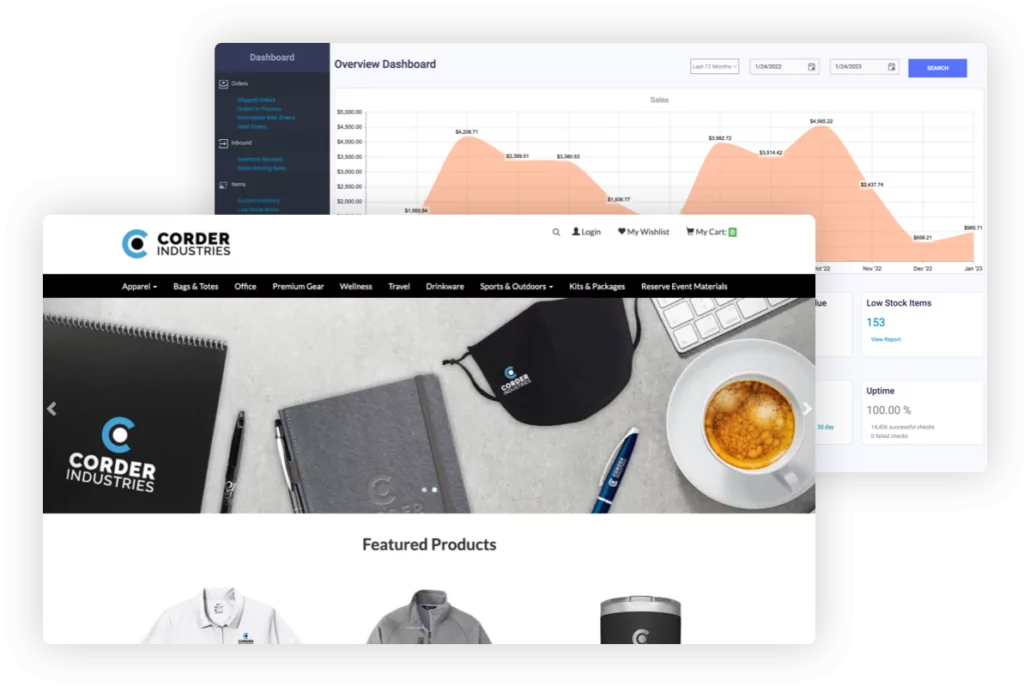
At Coggins, we see the online store as the front end. The real value is within the operating system behind it.
A fantastic system connects the entire program into one easily managed workflow. The storefront, inventory, on-demand production, and fulfillment work together, and orders move through correct fulfillment paths automatically. Payments, sales tax, store credit, and reimbursements run through that workflow too. Then reporting and ongoing administration complete it.
The benefits are different depending on who you ask. Employees get to enjoy a simple ordering experience. Administrators get better visibility and control, while marketing and HR teams spend less time managing additional details.
On-demand products are offered without creating additional manual work, and programs scale without adding new administrative burden. And that’s how operational execution becomes a competitive advantage.
It’s not the flashiest or most exciting part of the sales conversation, but it’s what separates a program that runs smoothly from one that becomes a giant, recurring headache.
Can One Company Store Really Handle Inventory and On-Demand Items?
Yes, and to be honest, far too many programs need it. Branded merchandise programs aren’t often inventory-based or purely on-demand. It’s combined.
A company might stock its most popular items for fast fulfillment, while still offering on-demand apparel, seasonal items, department-specific items, or products that simply shouldn’t be purchased in bulk. A hybrid model is powerful only if the operational process supports it.
It’s why Coggins is designed for precisely this. Items can ship from inventory, on-demand, or be combined, all in the same order. The user sees one seamless checkout while behind the scenes every item follows the correct path:
- In-stock products move through warehouse fulfillment
- On-demand can route into production
- Reporting still accounts for the full order
Complexity should always belong to the platform, not the client. No one on the client’s side should have to waste time manually coordinating two systems, vendors, spreadsheets, and invoices.
How Should a Company Store Handle Sales Tax?
Sales tax adds yet another complication to the process.
Tax compliance becomes an operational requirement once a company store accepts payments. It gets even more demanding when orders ship across state lines or the catalog includes different product types. Serving employees and customers in multiple locations and countries? This adds a third layer of difficulty.
We fully support automated sales tax calculation across 45 states, plus Washington, D.C. It’s incredibly important we do so, because most clients don’t want, or have the time to manage tax by hand. And Coggins believes you shouldn’t have to:
- Calculate the rates
- Track jurisdiction rules
- Reconcile the tax collected
- Wonder whether or not the amount calculated on every transaction was correct
Exceptional company store platforms should take this on. Let the client focus on the purpose of the program.
What Should a Company Store Reporting Cover?
Clear, accurate reporting is critical to a successful branded merchandising program. It can’t be an afterthought. Clients need and must know:
- What was ordered and who ordered it?
- Which department or location was each order tied to?
- How were payments handled?
- What inventory remains and what needs to be replenished?
- How should program costs be allocated?
This becomes more difficult as the program moves and takes off. Reporting becomes more challenging with:
- Multiple payment methods, store credits, reimbursements
- Company-paid and employee-paid items
- Inventory items and on-demand items
- Shipping charges, taxes, cost centers
At Coggins, we provide robust reporting that helps our clients understand activity, account for payments, and accurately calculate expense repayments.

Can Clients Distribute Merchandise and Credit Without Pre-Funding?
Yes. And we let our clients distribute merchandise and credit without pre-paying for account credit in advance.
Many programs need a way to get merchandise or purchasing power to employees, sales teams, customers, dealers, or event attendees. Requiring the client to pre-pay for account credit is one option, but it can create unnecessary cash flow issues and administrative friction. Removing that requirement can make a big difference. A company can run any of these without funding unused balances ahead of time:
- A redemption program
- An employee allowance
- A new hire experience
- A sales incentive
- A customer appreciation campaign
Instead of tying up money in prepaid credit, the program can be built around actual usage. That also means better reporting and cleaner reconciliation. It’s another example of operational infrastructure creating a better business process for the client
What Problems Show Up After an Online Company Store Launches?
Launching a store is an important milestone, but it isn’t the finish line. In many cases, the biggest challenges appear weeks or months later. That’s when the questions start. What happens when:
- A product goes out of stock?
- An employee enters the wrong address?
- One item ships from inventory and another has to be produced on demand?
- Sales tax needs to be calculated across multiple states?
- A department needs its own budget?
- A client wants to distribute credit without pre-paying unused balances?
- Finance needs accurate reimbursement reporting?
- Leadership asks for reporting by location, department, cost center, or payment type?
- The client wants to add new products, retire old ones, or control who can order what?
These aren’t rare edge cases. They’re the normal reality of running branded merchandise programs at scale, which is why process matters. A company store partner should be able to do more than launch the site. They should manage the ongoing program behind it.
How Does Operational Infrastructure Reduce Program Risks?
Branded merchandise may seem simple, but it’s highly visible inside an organization. When something goes wrong, the problem lands on a different team each time:
- A late employee welcome kit lands on HR.
- Event materials that miss their date hit the marketing team.
- Wrong inventory frustrates employees.
- Incorrect tax calculations fall to finance.
- Unclear reimbursements shake accounting’s confidence.
- Incomplete reporting leaves leadership unable to see what’s happening.
- A too-manual ordering process leaves administrators doing work the system should handle.
Strong operational infrastructure reduces those risks. It brings consistency and accountability, and it gives the client more control without requiring more effort.
That’s why the right partner is not just a vendor with products. It’s a company with the systems and technology to run the program, the people and processes to manage it, and the fulfillment capabilities to keep it running smoothly over time.
What Should Automation Do for a Company Store?
Automation is valuable only when it removes work from the client’s team. A strong branded merchandise platform should support these workflows without forcing the client to manage everything manually:
- Store credit, employee redemption programs, and new hire packages
- Approval rules and budget controls
- On-demand production and inventory fulfillment
- Reporting, tax calculation, and reimbursement tracking
When automation is built correctly, it creates a better experience for both administrators and end users. The client can rely on a defined process instead of sending one-off emails or uploading spreadsheets. Nobody has to approve every request manually, coordinate shipments order by order, or reconcile payments after the fact.
That’s the purpose of Coggins: to help companies run branded merchandise programs with less manual effort, better visibility, and more consistency.
Why Do the Best Company Stores Feel Simple?
A well-run company store feels simple to the user because the operational process behind it is strong. The easiest programs for users are often the most complex behind the scenes.
Employees shouldn’t have to understand the machinery behind an order. They should simply be able to get what they need, without learning:
- Inventory rules and production workflows
- Shipping processes
- Sales tax logic and cost centers
- Approval rules and repayment calculations
Administrators shouldn’t have to manage every detail by hand. They should have confidence that the system is doing what it’s supposed to do.
That’s what separates a basic online store from a true branded merchandise operating system.
What Questions Should You Always Ask for a Successful Company Store?
A good-looking store matters, but the real value starts after someone clicks “place order.” Before you choose a partner, ask:
- Does inventory update correctly, and does the on-demand item route into production? Can both live in the same order?
- Is sales tax calculated correctly, and are payments accounted for accurately?
- Can repayments be calculated cleanly, and can store credit be distributed without unnecessary pre-payment?
- Does fulfillment happen on time?
- Can you see what’s happening, and can the program grow without adding administrative work?
The answers mark the difference between a storefront and an operating system. At Coggins, we focus on the full program, from the technology, fulfillment, and on-demand production to the reporting, tax automation, payment accounting, and store credit behind every order, plus the process that ties them together.
In branded merchandise, the store is only the beginning. The real advantage is making everything work after launch.
Talk with Coggins about a company store program that runs smoothly behind the scenes, so your team can spend its time on the people the program was built for.